
Tech
A coach for the next buyer conversation
Inside Close-Rate’s new call preparation, interactive practice and follow-through workflows: visible evidence retrieval, scoped memory and one behavior to try next.
A rep gets off a difficult call. The buyer liked the product but wanted to wait. Before the next conversation, the useful question is specific: what should the rep ask to find out what is really holding the buyer back?
Today we are releasing call preparation, interactive practice, and follow-through in AI Insights. Reps can confirm the calls behind a preparation plan, rehearse one skill with a simulated buyer, and turn an agreed next step into a draft. Alongside them, Review my calls and Open my playbook complete one set of five shortcuts.
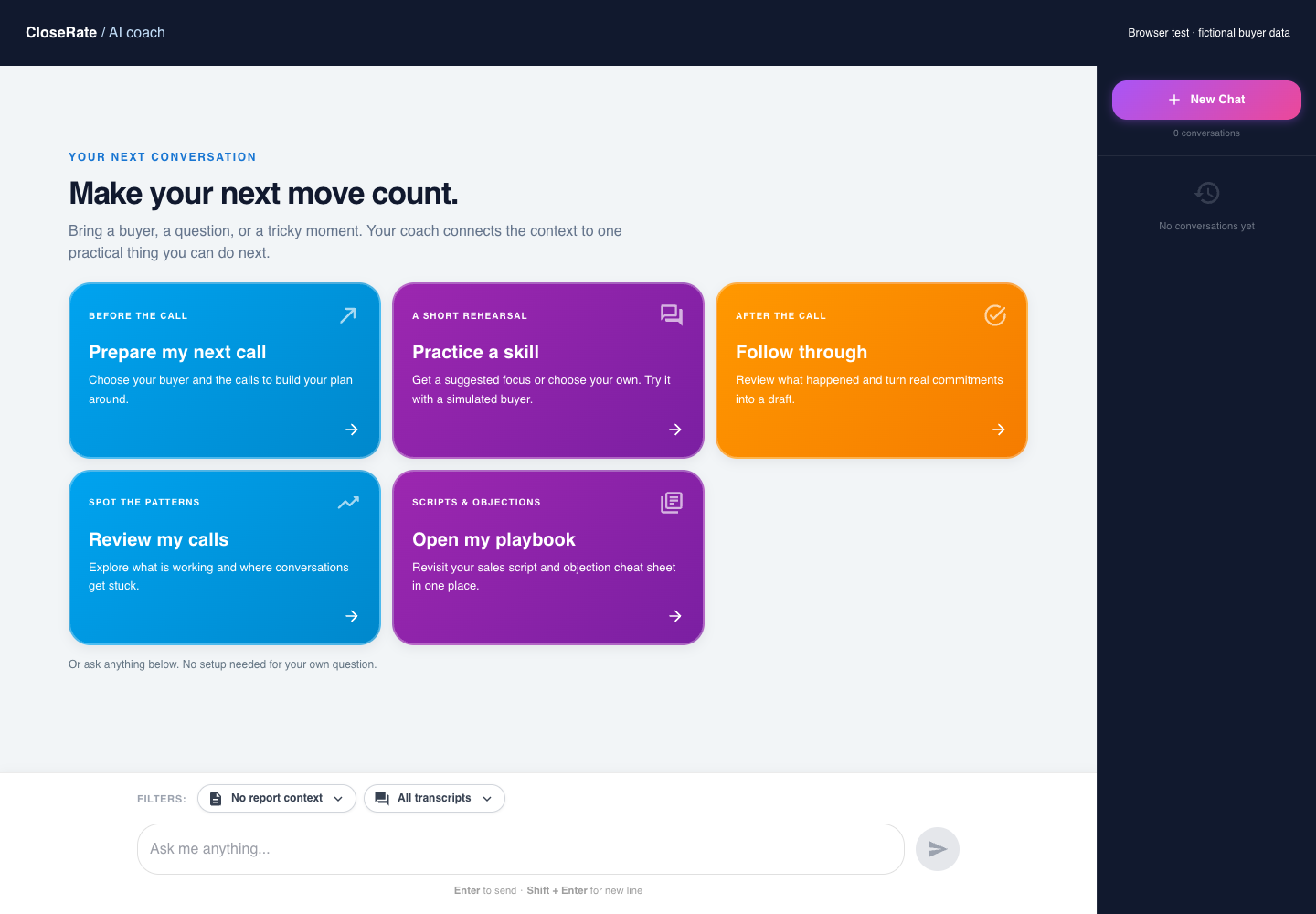
One behavior the rep can use
Preparation starts with a buyer or company name. The rep confirms which matching calls to use, or chooses “No previous call with this buyer.” That choice disables historical-call search. The coach can still use company materials and the details the rep supplies, but cannot borrow another buyer’s story to fill the gap.
Our preparation card has one focus, up to three questions, suggested wording, and a proposed next step. It separates call-linked observations from the rep’s own account and from AI inference. Unknown details stay visible. If the coach cannot identify the buyer, it is instructed to ask rather than write a personalized plan about someone else.
Suppose a buyer says the team is stretched. A useful question might be, “When you say next quarter, is that about available people, budget, or something else?” The answer changes what the rep should do. An implementation concern calls for a different conversation than a price concern. A genuine lack of fit may call for ending the pursuit.
We chose a narrow feedback unit deliberately. Research on AI sales coaches by Luo and colleagues found that inexperienced agents could struggle with feedback overload, and tested restricting feedback to one important suggestion. That informs our design; it does not establish how much Close-Rate will improve sales.
Practice includes the rep’s response
A rep can choose an objection, select calls or reports, or ask us to suggest a skill. For a suggestion, code looks for one recent, accessible individual report and selects an actionable recommendation from its lowest-scored eligible section. The model receives that recommendation as prior advice, then checks available call evidence before personalizing the exercise. Without supporting calls, it must label the exercise as hypothetical. The card explains the focus and offers “Choose another exercise.”
The practice card presents a clearly labeled simulated buyer and waits. The rep tries a response in their own words. The coach then has that response and the recent conversation available for feedback. A short exchange ends with one behavior to try on a real call; the rep can request the debrief sooner.
The application caps a practice run at three simulated-buyer turns before debriefing. The coach is instructed not to reward a phrase with an instant fictional purchase. A successful rehearsal is not proof that a real buyer is ready to buy.
Follow-through brings the same focus back into the conversation. Without new call evidence, the coach asks what happened and treats the reply as rep-reported. It can prepare an editable follow-up draft, with placeholders for unconfirmed owners or dates. There is no send tool. The rep reviews and copies the message.
What our model checks showed
We exercised the coaching model through seven scripted scenarios using fictional buyer dialogue and a fictional company playbook, then repeated preparation and practice checks after tightening the instructions. Storage was simulated; inference used the real providers. The coach opened the playbook, rejected a rep’s unauthorized discount and immediate-rollout promise, waited for practice replies, and declined to claim improvement when the rep had not yet made another call.
For a quick rehearsal, we keep the buyer’s prompt and the rep’s reply central, with brief feedback and expandable context. In our preparation checks, the coach asked for an account or transcript when no buyer was identified.
The checks also exposed a remaining limitation: one response summarized “mostly people” as “not a budget” concern, despite correctly listing budget as an unknown elsewhere. Finding the right excerpt does not guarantee a faithful interpretation. These are targeted scenario observations, not a blinded coaching-accuracy benchmark. The interface labels interpretations and keeps the original call accessible.
The context is visible
AI Insights now shows backend activity as it happens: checking recent history, including saved rep context, retrieving call evidence, and opening company materials or surrounding transcript passages. Each operation has its own icon and status. The saved answer keeps this receipt so the rep can inspect it later.
An available document and a document the coach actually read are separate events. A failed read produces a warning. These statuses describe application operations, not a model’s hidden reasoning. Call-linked summaries remain labeled as AI interpretations, and the rep can open the original call.
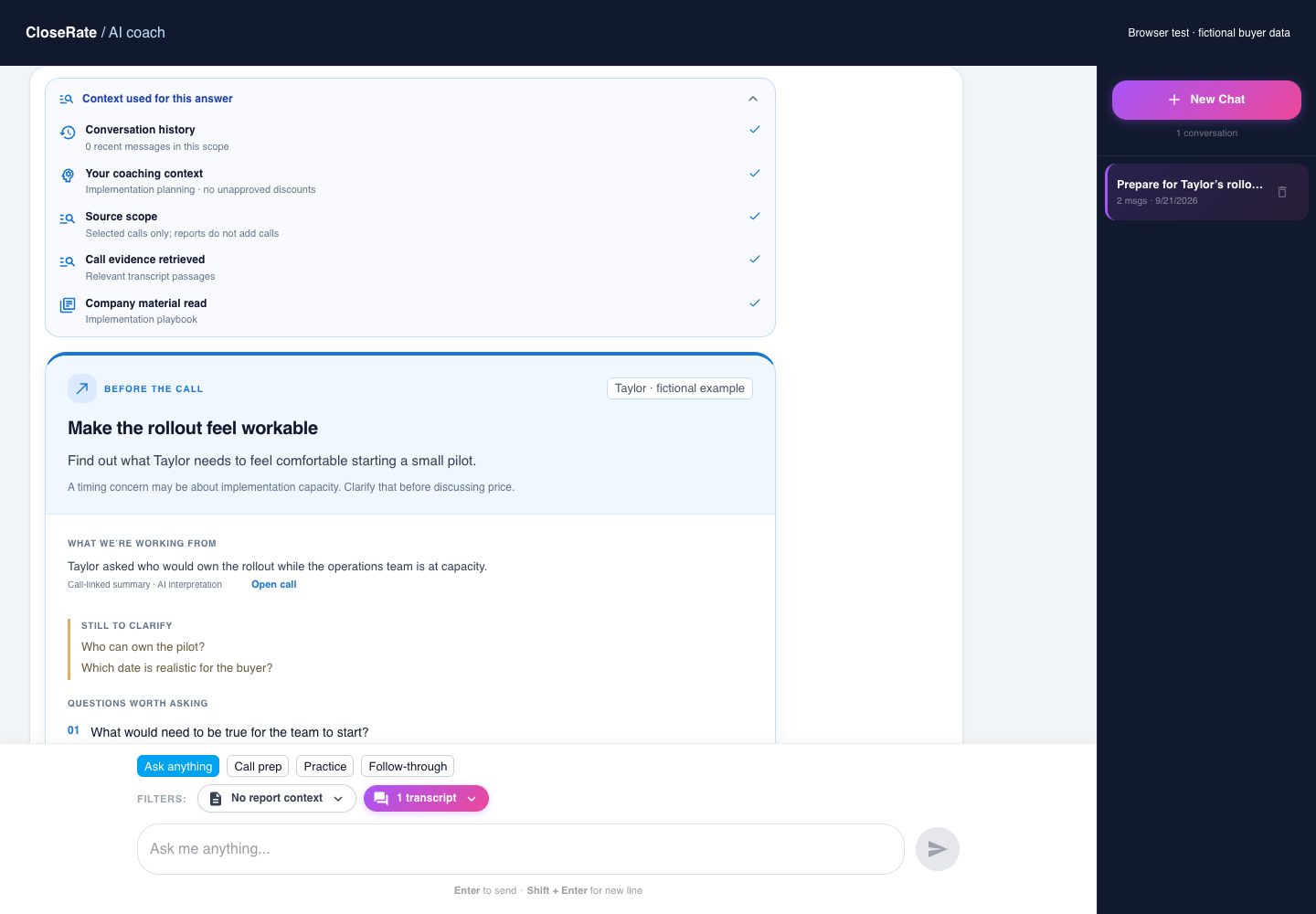
The coach receives a bounded set of recent, complete question-and-answer pairs from the current workspace and filter scope, so a rep can build on an earlier exchange. Changing the call or report filters starts a fresh evidence context. Earlier coaching remains advice; factual claims still need support from the selected calls.
From your question to one useful move
Source activity stays visible; practice replies are your choice.
A normal question still gets a normal answer
Typing a question does not open a setup dialog or automatically attach a coaching report. After an answer, the message box returns to Ask anything, including when the rep reopens a saved practice chat. Replying to the simulated buyer and requesting a debrief remain explicit actions inside the practice card.
Selected transcripts define the call evidence. Adding a report supplies coaching advice without adding its other calls. If only reports are selected, search is restricted to their linked calls. Preparation, practice and follow-through cap the initial context at 12 call summaries and 12 retrieved passages; attached-report excerpts share a 12,000-character budget. An automatic practice suggestion adds at most one report recommendation, rather than the rep’s entire reporting history.
Where Jev fits, and where code takes over
TypeSafe Jev continues to rank retrieved evidence. We also added a small typed workflow selector for free-form requests. A rep’s explicit choice of call preparation, practice, or follow-through takes precedence. Unavailable, invalid, or uncertain routing falls back to general coaching.
This routing threshold is a presentation guard, not a measured accuracy guarantee. TypeSafe’s confidence documentation makes that distinction explicit. Jev does not grant access, send messages, assign deal outcomes, or replace the generative model that writes coaching advice.
In a live-provider routing check, Jev chose the expected workflow on 40 of 40 authored requests: ten each for preparation, practice, follow-through, and general insights. Median end-to-end routing time was 0.37 seconds with three concurrent requests. This small, fixed English-language test checks intent selection; it is not a test of factual accuracy, calibration, or real-world sales performance.
The transcript tool accepts only call IDs already authorized for this request, then checks access again before reading storage. It returns a bounded passage. Each retrieval round permits at most two transcript reads and two company-document reads, and the request has a deadline. Questions and answers are saved together in one database transaction.
Reports grounded in the calls you select
Each report applies a consistent coaching rubric to evidence from the selected calls. Discovery, value presentation and closing assessments draw on what participants said. A deal outcome alone does not establish which selling behaviors occurred. The rep can review the source exchanges behind the coaching and decide what to work on next.
Independent evidence searches run concurrently within report sections, with a shared limit of four searches per report service instance. Excerpts retain their call identity when deduplicated, and coverage warnings show when a supporting search is incomplete. This applies parallel agent design to work that can run independently.
We test workspace isolation, structured responses, retrieval limits, partial streaming responses, saved conversation turns, and desktop and mobile interactions. The browser screenshots use fictional service responses. These checks establish software behavior. Evaluating coaching accuracy and sales impact requires expert assessment, subsequent calls and confirmed deal results.
Open AI Insights to prepare for a buyer, try a short rehearsal, or ask your own question.